|
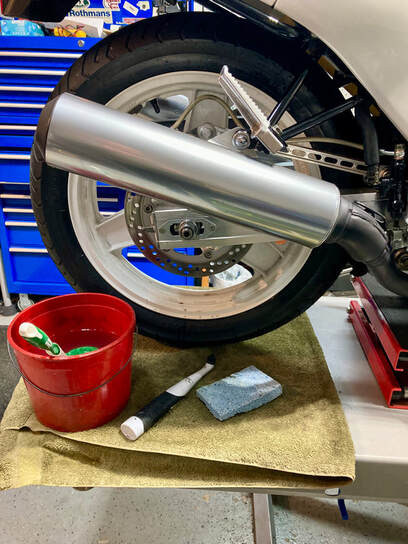
Some, but not all, of our coolant hose clamps are still available from Father Honda, but these are very good quality clamps and if they're not damaged in some way, I give the originals a little refurbishing and a fresh lease on life. First they get a cleaning in WD-40 or similar. I then exercise them by running the screw back and forth several times — if I'm doing several I'll attach the 6mm socket to a drill adaptor as I look for smooth operation with no apparent damage. A thorough wipe down and back on the bike.
0 Comments
Well…this can't be good. When owner Jeff dropped off Project 31, a 1986 VFR700 F2, he mentioned that there might be a cooling issue. As part of my initial maintenance, I flush the system, and in this case the coolant was chocolate brown in color. The thermostat was replaced and upon restart there was still marginal coolant flow, which indicated a peek at the water pump — this is what I found upon removing the cover. Don't think a coolant change should be a part of your maintenance schedule? This is what you risk. Those steel impeller blades were literally rotted away after years of sitting in corrosive coolant. The level of coolant is obvious and if you turned those blades 180-degrees, the blades are missing at that level. The remaining blades were barely hanging on. So, what to do? The pump is long gone from Honda's parts shelves, but it turns out there's a water pump savior in Arizona, Tom, who operates azv65.com. He rebuilds V4 water pumps and provides miscellaneous seals etc. for those models, and, fortunately, the Interceptor pumps are so similar that he's also able to help out us VFR guys. Tom is a great guy, and he soon had a fresh pump at my doorstep. When I opened the package I was impressed, to say the least. I doubt that the original Honda part looked this good. Mine you, these metal parts are used originals which Tom has restored to new condition, then alodined to this beautiful, durable finish. It's ready for paint or can be installed as is. And, here we are during installation. I left the housing in the alodine finish but painted the cover black to match the engine. Removal and installation on the 2d-gen Interceptor is very simple. Once the four cover bolts, cover and rear coolant hose (the blue hose pictured here) are removed, the entire pump simply pulls outward. The new pump is slid back into place (while engaging the driveshaft notch) and the four cover bolts secure it in place. Thanks to Tom, this VFR will keep its cool for many years to come. HEY!! Tom is considering selling his part-time pump business to someone who will continue this important service. He's invested many, many hours of skill and experimentation to perfect this process. For a nominal investment he's willing to provide his knowledge, inventory and equipment. Contact Tom via his website.
Click on image for the ADVrider link What: 1983 VF400F Where: Pittsburgh, PA area Why: Rare, cool, lo-miles, unique in U.S. Price: $3950 OBO Here's an interesting V4 sport bike produced for the Japanese domestic market in 1982 and '83. This is the model that spawned our VF500F and the specs are familiar; high-compression, high-redline V4, 16/18" wheels, TRAC, 6-speed, bikini fairing. The model also featured Honda's answer to a question no one asked: inboard (covered) disc brakes front and rear. This example shows only 1973 miles and is fitted with aftermarket rearsets. The seller has sourced a set of OEM brackets to put the pegs back to stock, but is still missing the foot pegs. The OEM front turn signals are also MIA. The seller is asking $3950, and with so few of these changing hands in the U.S., the street value will ultimately be up to the buyer and seller. Click on image for the FB M'place listing Need a new seat for your 1990-93 VFR? Here we have a forever-stored new-bike take-off, in black. Available in exotic Paris...ahh…Kentucky, our seller is asking $155 and will ship for an additional $50. The 1990 seat was gray, of course, but not to say this might provide a little more modern look. If the condition is, in fact, "perfect" as the seller states, this is a great find for a "new" OEM seat. A few days ago, Brett, the proud owner of Project 33, a 1993 VFR750F in original Pearl Crystal White, emailed me with a question about his brother-in-law's newest acquisition, a 2007 VFR800 Anniversary Edition. Brett also mentioned that he'd recently gotten the '93 down to the Smoky Mountains for a few days of riding bliss. When someone in my small part of the VFR universe casually mentions that they've taken their Interceptor on a special ride, no matter where that may be, I doubt that they realize how satisfying those words are to me. Helping to rescue a forgotten, forlorn machine from the corner of a dark shed and put it back in the hands of someone who will see it with fresh eyes and fresh enthusiasm is a reminder of why I keep doing this work.
Someone commented to me once regarding this website by saying, "Wow, you flip a lot of VFRs." I wasn't sure how to take that. I hope that what I do isn't "flipping." Spending 80 to 100 hours in an effort to breathe life back into these special motorcycles is often dirty, tedious, thankless work. I call this "sympathetic restoration" — that's when you do your best to bring an example up to the best standard it can be while still being true to its unique overall condition, history and originality, all the while trying to avoid looking restored. That requires attention to every detail, down to every screw head, knowing full well that no one will likely appreciate the effort. But anyone who's done this kind of work understands that those details are what define the whole. These classic VFRs can hold their own 30 to 40 years after leaving the showroom. They have looks, charisma and the charm that only a vintage road machine can provide. The V4 development was Soichiro Honda's pet project, culminating in the RC30, RC45 and RC213V-S. And, in my opinion, no GSX, CBR or ZX7 can touch 'em. So, thanks for sharing, Brett, and reminding me of why we do this. For all you blue/gray second-gen Interceptor fans, former Project 28 is being offered for sale by its owner, Joe Marelli. The bike is located in Palatine, Illinois, a northwest suburb of Chicago. Asking price is $4200. Joe contacted me in Spring of 2020 about bringing his old friend back to the road. The issues were common to bikes which sit idle for too long — locked up brakes, clogged carburetors, stale gas, aged tires, etc. I set about a cosmetic and mechanical refurbishment and two months later he had his baby back. This 1987 VFR700 F2 shows only 12,346 miles and is all original including mufflers, bodywork and rear seat cowl with upgraded stainless brake lines.
For information contact Joe at [email protected] (click on an image to enlarge) Click on image for the Craigslist ad I've never seen one of these cool VF1000R dust covers. It turns out they were a limited edition made at the request of the VF1000R Facebook group, and are still available from Tyga for $63, plus shipping, presumably. I came across this one on my local C-list, the seller asking $75. Pretty cool. Yesterday I completed the long-awaited test ride of Project 31, a 1986 VFR700 F2. The test went well; the engine is smooth, carburetion is spot-on and it handles great. But, as I sat at a stoplight with the clutch lever held in, I could feel that the clutch was creeping ever so slightly toward engaging. I knew I had a clutch hydraulic issue. I rarely break my personal rule of inspecting every component, but I made an exception with Project 31's clutch hydraulics. While cleaning and inspecting the master and slave cylinders I could see that fresh overhaul kits had been installed sometime in the not-to-distant past, so I let them pass. My mistake, as disassembly of the clutch master revealed a ring of corrosion in the bore (pink arrow in this photo). The rubber seal can't hold an effective seal at this point in its travel, hence the leakback causing the creeping clutch engagement. I can't hone or otherwise repair this tiny aluminum bore, so a replacement master is required. I had a feeling that I should open up the clutch slave for a closer inspection as well. Good thing I did. The assembly was clean and there was, in fact, fresh seals installed…but the main seal was installed backwards! Amazingly, it functioned that way, but come on…even the Factory Service Manual clearly pictures the correct orientation. I can't trust the used seal, so a fresh one was fitted. Yet another reminder to always verify someone else's prior work. TIP: When servicing the clutch slave cylinder, here's a way to remove the piston without the mess of disturbing the hydraulic line. I unbolt the assembly and hold it over a small bucket while slowly pumping the clutch lever, forcing the piston (and fluid) out of its bore. The fluid empties into the bucket, avoiding the inevitable leakage onto the engine if the line is disconnected in situ. If you need the line removed for a more thorough service, an impact driver will easily remove its bolt. In this case I was able to simply wipe clean the empty bore, refit the piston with its new seals, and bolt the assembly back onto the engine. Quick and clean. Click on image for the VFRworld.com ad What: 2007 VFR800 Where: Charlotte, N. Carolina Why: Low miles, unmolested Price: $5000 If you were shopping for a new Interceptor in 2007 your color choices were two: the r/w/b Anniversary Edition or this more Honda-like Candy Glory Red. Today's example is a one-owner, purchased new in 2010 and ridden only 5500 miles. The seller claims the bike is unmodified, never down and "not a scratch on it," excepting some scuffs on the matching OEM saddlebags. The title is clean and the price firm. If you're in the market for a new-looking sixth-generation Interceptor, your search could easily end here. Back in June a very special Interceptor was off-loaded from the transporter after its long trek from south Florida. This example is unique for a few reasons, the most significant being the 1112 miles showing on the odometer. The bike is a one-owner 1986 VFR700F in red/white/blue with original everything, right down to the tires and battery (drained and bagged). Some history: Seller Jim purchased his new Interceptor as a showroom "left-over" from Gables Honda, Miami Florida, on November 28, 1988 (now Gables Motorsports & Marine). The selling price was $3979 plus fees and tax, giving an out-the-door total of $4257, according to the original sales contract provided with the sale. Jim also provided the second key, still with its protective plastic sheath, tool kit, owners manual, an unused Factory Service Manual and the optional center stand in its factory wrapper. Jim managed to put a few miles on his new bike before hurricane Andrew hit south Florida in 1992, the most destructive U.S. hurricane of record. Jim was then busied rebuilding BP facilities throughout south Florida for the next few years. When the VFR eventually failed to come back to life, weeks turned into months and months into years. It would be three decades before Jim decided to finally resurrect his "new" bike. He completed a thorough brake system rebuild before contacting me about some carburetor parts. After some discussion the possibility of a sale came up…and it became my project…Project 35. I immediately took to checking the mechanical basics of valve checks (a few intakes and all exhaust valves were tight), compression check and visual inspection of electrical, fuel line replacements, etc. The gooey carburetors were tended to, installed, and the old engine came to life without hesitation. After a carb syncing, the bike was running well, so as a final check I ventured out on a short test ride to verify that the suspension, clutch and transmission were correct — it was a tentative outing due to the 35 year-old rubber, but everything checked out and the bike felt tight, together…basically what a new 1986 Honda VFR would feel like. This was a very special experience for a VFR geek like myself. I've developed a plan to keep this bike in its original state while bringing the mechanical systems up to snuff. It will be a running, riding time capsule. And it may well be on the podium at the 2022 Las Vegas auctions. It's a bittersweet reality that rare, original finds like this one have reached the collectability stage in their life where further miles and risk of damage are counter-productive to the bike's monetary and aesthetic appeal. But, that will be up to its next caretaker. (click on an image to enlarge) |
THE SHOP BLOG
|


RSS Feed