I think the 4th-gen looks great in silver with black. Congratulations to Marco and his exceptional rescue.
|
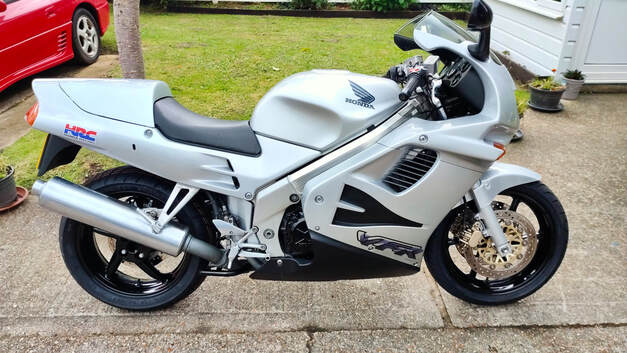
A reader from the UK sent along some photos and his story with this beautiful silver 4th-gen VFR. Marco found his bike as a non-running project on the Isle of Wight, an island off the south coast of England. It had been inactive since 2010 and was being offered for £700. Marco and the seller settled on £550 ($749), figuring he's not out much if things didn't work out. But they did. With lots of carburetor work, fuel system flushed, tires, full brake service, filters, etc., the Honda fired up, ran and rode well. I think the 4th-gen looks great in silver with black. Congratulations to Marco and his exceptional rescue.
0 Comments
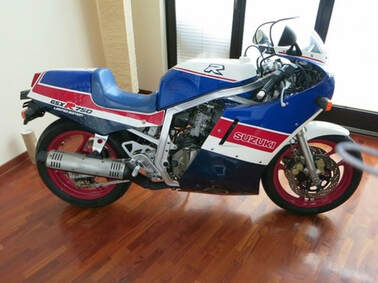
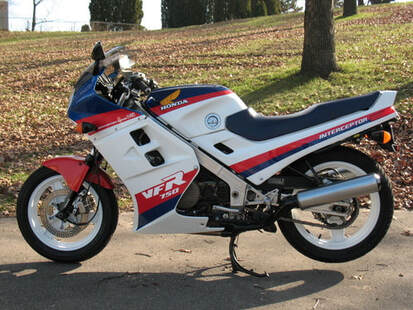
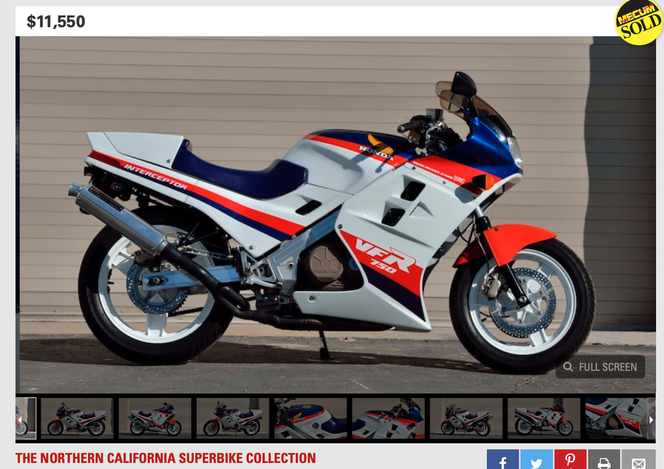
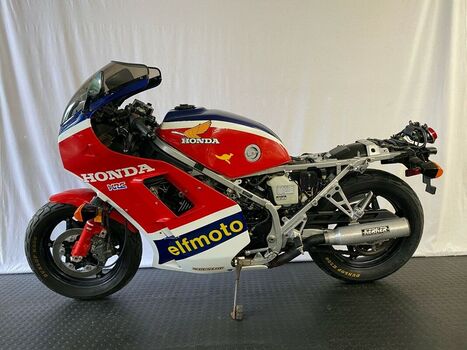
September 2015 Aesthetics "One is apt to overestimate beauty when it is rare," wrote Mark Twain. This observation holds true in our sport more times than I'd care to admit — the Munch Mammoth of 1969 comes to mind. Obviously, I'm biased toward the Interceptors when it comes to classic sport bikes, but there's one period comparison that I've never quite understood, and that's the visual attraction of the original Suzuki GSX-R750. Here we have an example of Suzuki's best effort in 1986, the GSX-R750 Limited Edition. The LE boasted a nearly 60% price premium over the standard model, and for that the buyer got a dry clutch and seven pound weight savings. At $6500 it was the most expensive Japanese sport bike available. I'm certain that many see a pleasing aesthetic in its pudgy body, Electrolux exhaust and garish paint, but it escapes me. Compare the GSX-R to the same year Honda Interceptor. Lines, angles, shapes, color. These design elements blend into a cohesive style; lithe, light and sexy. I don't know what style Suzuki was chasing — Steampunk Endurance Racer? — but they missed the mark. And don't get me started on engineering and build quality.... Yes, you're seeing that correctly…the bike pictured below sold for $11,550 at Mecum's Las Vegas auction, held this year at the end of April. This example represents an above average 1986 VFR750F showing 18,665 miles and coming out of the Northern California Superbike Collection.
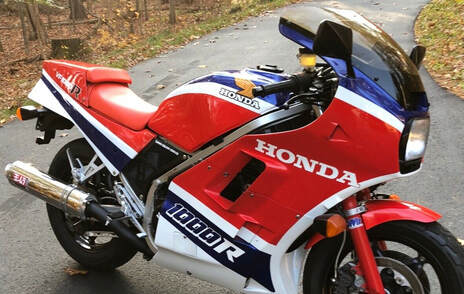
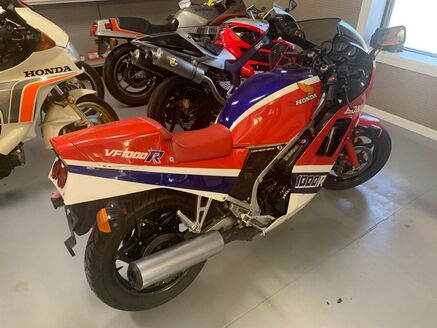
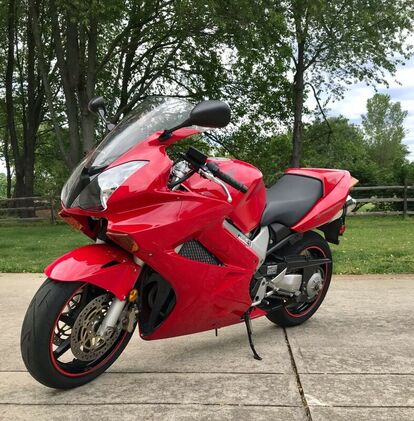
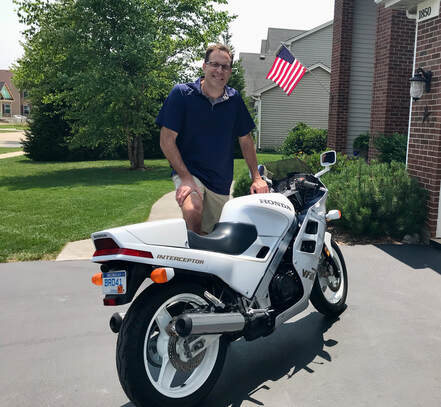
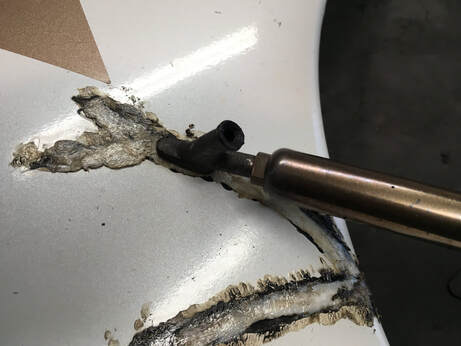
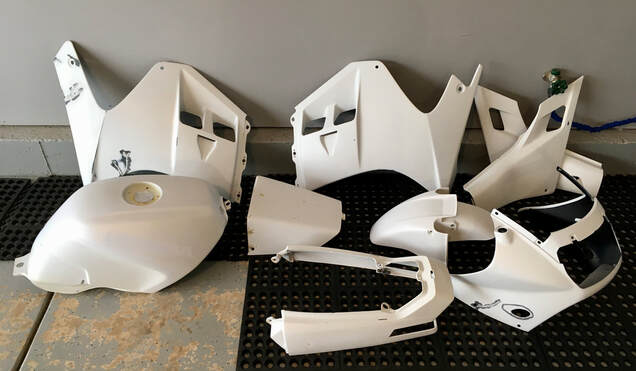
Mecum gives very sparse details (which aren't always accurate) on their auction bikes, in this case stating, "factory stock condition with no modifications." Well, there's the Yoshimura 4-into-1 slip-on, braided brake lines, aftermarket rear turn signals, missing passenger pegs and incorrect black painted radiator screen…but caveat emptor, right? As for condition, this is a very nice rider with below average miles (~25,000 is average for the 2d-gen bikes in my experience) and several touched-up spots on the paintwork, notably the left side fairings, which obviously met the ground at some point. All I can say is, WOW, well-sold. The real significance of this sale, I hope, is that it signals a long-overdue value increase for second-gen Interceptors. Click on image for the eBay link What: 1985 VF1000R (project) Where: Pepperell, Massachusetts Why: Nice example, but…. Price: eBay auction Up for a project? No, not the Swamp Thing, or someone's freshly crashed "streetfighter." This one is a nicely presented square-headlight 1985 model (with a round-light '86 paint job) showing only 16,020 miles and several desirable upgrades already accomplished, including suspension, exhaust, paint and brake lines. The elephant in the room is the oil dripping out of the head gasket area of #2 cylinder. Not being a VF guy, I'm not sure if this requires an engine removal, but it will be an involved repair in any case. If you're up for it you'll be rewarded with a very pretty big-block V4 with lots of miles in its future. Bidding is at $1763, reserve not met, with four days left in the auction. Two widely divergent VF1000Rs sold recently via eBay auctions, one a project or parts bike (with parts missing), the other a nice running example. The value difference came out to $5452. Click on image for the eBay link First up is this 1985 with a claimed 4845 miles. What you see is what you get, minus a title and not run since 2004. This will be a real gamble for the buyer if he/she is interested in a useable engine, as one has to wonder why a high-end sport bike was parked with so few miles. Beyond that, it might serve as a parts bike or a project basis if a title can be secured. Sold for $2200 with 22 bids. Click on image for the eBay link Next up is this pretty 1985 example showing 11,628 miles and in need of only a battery, according to the listing. Details are scarce but is described as "very clean" and "coming out of a private collection." The photos indeed show a very clean bike, complete and original. Well bought for $7652 with 28 bids. Click on image for eBay link What: 2002 VFR800 ABS Where: Swedesboro, New Jersey Why: Low miles, well-kept, ABS Price: $4650 BIN, or Make Offer There's a combination of factors making this first-year VTEC 800 a bit special, beginning with a life of light use as evidenced by the 12,953 miles showing on the odometer. It's also adult-owned and obviously well cared for and maintained, while the Delkevic stainless slip-ons are a nice touch to highlight that magical V4 music. The rear fender isn't chopped, it hasn't been flung down the road on its side and there's no boy-racer decals sullying the Italian Red paintwork. The red wheel stripes can be easily removed, if desired. The maintenance is up to date and all the original parts are there along with tool kit, manuals, etc. All-in-all, a very nice package with the safety advantage of ABS brakes. Yesterday another project left the shop as owner Steve brought his trailer to take his baby home to Michigan. Project 34 is a sparkling 1987 VFR700 F2 with 23,300 miles on the odometer. Steve's Interceptor got a cosmetic and mechanical make-over and is now ready for many more miles and smiles. Steve's owned the bike for many years as it's followed him around the country through moves and a growing family, but he knew the day would come when he and the bike would return to the road. Yesterday was that day. The carburetors on this one were among the worst in my experience, but once they were sorted the bike came together bit by bit, always with an emphasis on keeping the bike's originality and character in tact. I think we achieved that goal as this is a beautiful survivor, with a look, sound and feel right from 1987. I hope Steve is proud of his VFR and they enjoy many years of safe and enjoyable rides together. Photo album. The next big task on Project 32, a 1986 VFR700 F2 in Pearl Crescent White, is a full repaint. Paint prep is time-consuming, but critical for a quality job. I begin with a thorough degreasing and general cleaning, then plastic repairs, and finally decal removal, at which point I turn the parts over to a professional for final finishing and painting. In this case, repairs were necessary to the large right side fairing, headlight fairing, tail light fairing mounting tabs and the rear seat cowl. Here, I'm pealing away the ancient duct tape "repair" on the right side fairing. There were two similar cracked areas on this piece. I'll be plastic welding these cracks so I begin with V-grooving the cracks with a Dremel tool on both sides of the fairing. I use a small cutting head or, for larger areas, a flexible sanding head. (click on an image to enlarge) Next I weld ABS filler rod into the cracks, smoothing the filler with heat to keep the repair at or below the surface of the piece (as seen on the lower crack weld). This will make finishing easier, as the ABS is difficult to sand. This done on both sides of the repair. (Below) We've decided to fill the grooves around the turn signal holes on the headlight fairing, just for cosmetics. These grooves were part of a lazy fix for Honda to add the infill panels necessary to fit the U.S.-spec turn signals and their mounting stalks. Filling the grooves will clean up the fairing, giving a more finished look. I want to enlarge the groove here, in order to fill it with Plast-aid, a two-part acetate plastic product. In it's liquid state, the Plast-aid will level itself to the surface, making final finishing fairly straight-forward. Once cured (about 20 minutes) the area is sanded with 100-grit to smooth out the excess and prep the surface for body filler. These pieces are ready for the painter.
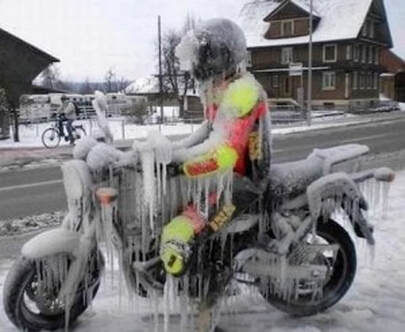
Today marks the mid-point of the riding season for those of us living on the upper third of the globe. It happens to be raining outside my window this morning, but the calendar is a reminder to get out and recycle some petrol, else we end up like this in a few months time….
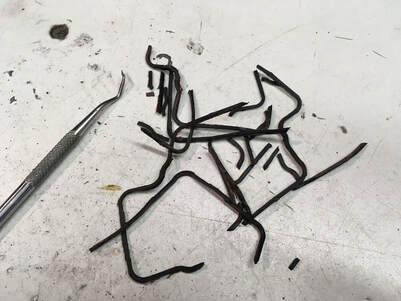
When I come across original bowl gaskets on my projects, they're often very difficult to remove. Pictured here is what's left of 35-year old, never-touched gaskets on a recent project, which fought me every millimeter of the way. What's left behind in the bowl's groove is a crisp, hard varnished substance, which appears to be a cement used in factory assembly. I want this stuff removed, but it too puts up a fight. I've found that soaking the affected part of the cover overnight in a shallow dish of acetone will make the adhesive easier to remove using a brass wire hand or rotary brush mounted in a drill or Dremel. The brown gasoline residue in the bowl will clean up with a water-based degreaser and tooth brush. |
THE SHOP BLOG
|


RSS Feed