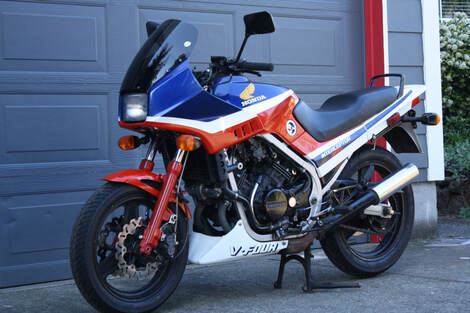
Click on image for the eBay link. What: VF1100-powered trike Where: Corpus Christi, Texas Why: I have no idea Price: Auction, $1000 opening bid I'm continually amazed at the contraptions people will build, often at considerable expense and commitment. I'm reminded of a judge's admonishment to the hardened criminal he's sentencing to consecutive life terms; "If only you would have put your evil genius to productive use...." Here's a perfect example, with a twist — it's powered by what appears to be a VF1100 engine driving the rear wheels through a swing axle differential. The substantial front suspension looks like something from a road grader and, if the yellow paint doesn't get your attention, maybe the plastic skull mounted atop the roll bar with its glowing red eyes will. To add yet another layer of horror, there's a trailer hitch installed (!). The rear-facing signage is prophetic; "Know Fear." Click on image for the eBay link. What: 1984 700 Sabre Where: Malabar, Florida Why: Original, super low miles Price: $4500 One of two models leading the V4 charge in 1982, the VF750S, marketed as the V45 Sabre, was a standard-style roadster which differentiated itself by featuring Honda's new V4 with shaft drive. In its third year all U.S. Sabres were downsized to "tariff-buster" 700cc models, losing the V45 designator. 1985 would be the last year of the 700 Sabre. This example has an amazing 1965 miles on the odometer, appears to be in completely original spec, and has had the required maintenance completed. The description is sparse, but the photos are impressive. Our seller has listed the bike for an equally impressive $4500 buy-it-now, but your chances of finding another early Sabre in this condition are admittedly small. This would make a great addition to a V4 collection or an exquisite classic Honda to enjoy. One of the final bits to finish on the freshening of Project 9 is to install the windscreen molding. This is a vinyl strip that surrounds the exposed edge of the windscreen. It's a factory part, but is no longer available from Honda. Fortunately, I have a few in the warehouse, so let's get it on the bike. The molding is designed to install by simply pressing onto the windscreen edge, held by friction. In the past, I've had to add a bit of clear adhesive to older molding which had lost its elasticity, but this NOS molding installed easily, with a little help from warming with the heat gun. (Below) Be careful with the heat; the molding has a low melting temperature, which I quickly discovered. Fortunately, extra material is supplied. When I reached the end I snipped off the excess. One thing to note about the little molding clips, which secure the molding at either end, is that they have an open end and a closed end, so they must install as shown. Slip the clip onto the end of the molding, then with a firm push it pops onto the windscreen, holding the end securely. If yours are missing, these clips are still available from Honda. Finally, I gently heat the entire length of the molding making sure it's evenly seated. Job done. This past December 16th the shippers arrived at the expansive V4 Dreams campus to load Project 11 onto a cargo truck, the beginning of its long journey to Haugesund, Norway. The bike's new owner, Nils, took a huge leap of faith with me to purchase the 1986 VFR700F and ship it across the Atlantic. Nils, an admittedly impatient sort, busied himself during the two-month shipping wait acquiring OEM mufflers and centerstand, refinishing them in preparation to pass the strict licensing rules of Norway which require a stock configuration. One of the mufflers came from me and one was sourced in Germany. Eventually the day came, the crate unloaded and the Interceptor unveiled to Nils and 4-year old Jacob for the first time. Nils immediately set to work wrestling the mufflers into place and mounting the centerstand. He now has possibly the only U.S.-spec "tariff-buster" 700cc Interceptor in Europe. It's in original condition, shows 23,475 miles and is a beautiful example. And Jacob is a huge fan. Wouldn't it be great if one day it became his.
Facebook's Marketplace has become popular for selling anything and everything, with little consideration for class, decorum, language or photography skills. While casually browsing the other day I came across these three frightening Interceptors offered for sale, plus one that defies sound judgement. (Below) First up is this questionable 1992 VFR750 with an ominous 111,111 miles, purchased by the seller as a parts bike, and conveniently pre-stripped of pretty much anything of value, save for the 8-spoke rear wheel. Described as needing a headlight and "could certainly stand a little cosmetic makeover," the seller is offering it for $1250 firm, but "this weekend only" it can be yours for only $950. Presumably it will go back up to $1250 on Monday if unsold. (Below) Next up is a 1995 VFR750 showing only 25,000 miles but looking a bit worse for wear. Turns out it's been sitting for some ten years and, not surprisingly, "is not currently running." But, rest assured, it was running when parked and had, at the time, been treated to new tires, brakes and fluids. Some of the body plastics have gone missing "from sitting around." No doubt a result of those pesky parts-stealing gnomes who sneak into your garage at night and make off with your bike parts. Our seller adds, endearingly, that he's "tired of looking at the damned thing," and then confusingly offers it for $1000 OBO, then states he's firm on the price (?) yet has changed the listing price to $825. Good luck to seller and buyer. (Below) Last, but not at all least, we have this beast, a 1985 VF700, looking fresh from the swamp. Our seller has gotten "bored with it" (makes me wonder where the original interest came from) and has "never gotten around to getting a title for it." No wonder, as a VIN tag has obviously been pop riveted onto the frame. The price has been lowered to $600 and we're invited to bring our own battery to hear it run. I'll be right over.... (Below) And here we have yet another victim in the VFR trike pandemic. This hapless 1986 VFR700 has been forced into service in a homebuilt Slingshot-style trike affair. The seller aptly notes that it is a very fast "drifter." I'll just bet it is. I'm no safety nazi, but I sure would feel better seeing some seat belts mounted.
The Gulf baby blue and orange racing paint scheme was a common sight fifty years ago, made famous on the Le Mans-winning Porsche 917 cars in 1970 and '71. Its place in history was assured through the Steve McQueen movie Le Mans (1971), the car used in the film selling at a 2017 auction for $14 million. Suffice it to say that the Gulf livery colors have been cemented into racing lore and our collective memories.
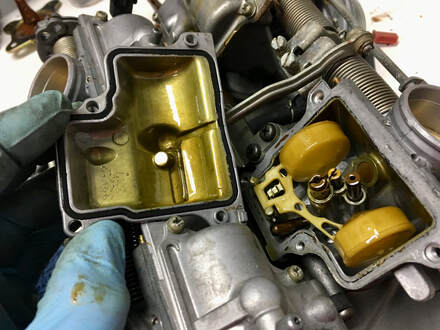
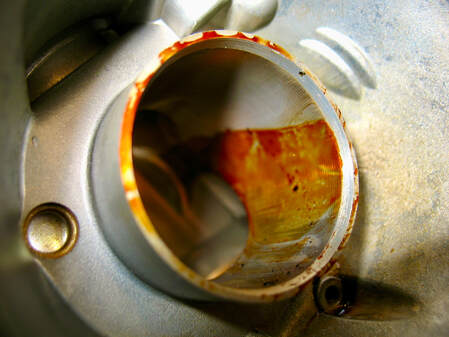
I don't know who to credit with this fourth-gen rebuild, but they were fully committed to the look and pulled it off nicely. Without a racing pedigree, the fourth-gen might seem an unusual choice for racing colors, but that's the nice thing about our bikes; we can realize our own vision. Fortunately, during these isolated times, I have lots of shop projects to keep me busy. Project 9, a 1986 VFR750F, has undergone a maintenance regimen, including carburetor cleaning/syncing, stator hardwired, fresh tires mounted, brake checks, fluid flushes, and lots of little chores completed. (Below) I found mice evidence in the airbox which, fortunately, had not damaged the carbs below. This is a stock tuned engine with an OEM air filter installed when I did the original refurbishment eight years ago. The OEM filter is NLA from Honda, but HiFlofiltro now offers an identical-looking replacement which I sourced from Amazon for $20. (part #HFA1707) (click on images to enlarge) (Below) I was interested in disassembling this particular set of carburetors to see how my VITON bowl gaskets and NAPA rubber vacuum caps (for deleting the CA emissions) had withstood eight years of use. The bowl gaskets looked like new, but the same can't be said for the vacuum caps, which had begun to crack and possibly leak. These caps are designed for engine use, so I was surprised to discover this. After some research, I've sourced some 3/16" silicone caps designed for hi-temp applications, so should last a long time. The baby blue color is just a bonus. (Below) The carburetors were still clean and the jets clear, so I just upgraded the fuel tube o-rings and fuel lines, reassembled, then leak-tested. (Below) Next, I found that the headlight was working intermittently, which I traced to the starter switch — this switch is designed to turn off the headlight when depressed. I have found this issue in past projects, and it's simply a matter of the switch contacts becoming contaminated with years of dirt accumulation. The photo points to the switch box, and once removed I simply spray the contacts with electronic cleaner followed by a thin coating of dielectric grease to prevent corrosion. While the assembly is apart, I clean the throttle tube inside and out, and dab some grease on the cable ferules. Job done. (Below) If the right-side switch gear was gummy, I thought I should check the left side. Good thing. The first sign of trouble was the mud dauber nest (arrows). But glancing at the choke cable, I found the cable frayed with only a few strands remaining. It wasn't long for this world. Turns out the cable is NLA from Honda and I couldn't find an aftermarket available in the U.S. Fortunately, I found one in the massive V4 Dreams secret underground parts stash facility so I was able to clean, lube and reassemble. (Right) With the carbs off, I always have a peek at the intake tracts, looking for carbon buildup on the valves and valve stems. These are the cleanest I've ever seen on an older VFR, in fact, they look nearly new. Once the wheels/tires are remounted, this one will be ready for the bodywork to be installed and its test ride.
A recent WebBikeWorld.com article by Simon Bertram caught my attention by virtue of its title: The Best Honda Motorcycles Ever Made. That's an ambitious subject, considering we're talking about the world's largest motorsport manufacturer. The lead photo (right) features Bubba Shobert on his championship winning VFR, so one might suspect that the Interceptor won a spot in the list, and it kind of did, by way of the VFR750R, aka RC30. From the author: "...what makes the VFR750R one of the best Honda bikes ever made, is that they were essentially race bikes with street parts on them. If you bought the right HRC parts, which in and of itself was difficult, you could quite literally ride around on a perfectly street legal racing bike. The VFR750R RC30 goes down in history as the winner of the first two World SBK Championship seasons, as well as one of the best homologation specials ever made, and is one of the most sought after Honda bikes of all time for the collector’s market. It’s also one of the greatest Honda motorcycles ever made simply because it was designed, made, and built for one purpose only: to utterly destroy every other manufacturer on the track, which it did in fine style." Also listed was the NR750 V4: "This, here, was the bike that launched the hypersport name. This, here, was the motorcycle that dared to push the limits of what was acceptable in a street bike. This, here, was the beast that revolutionized so much about motorcycles that it is cemented in history. This, here, is the 1992 Honda NR750." For more on what makes the NR historically significant, check out this VisorDown article.
|
THE SHOP BLOG
|


RSS Feed