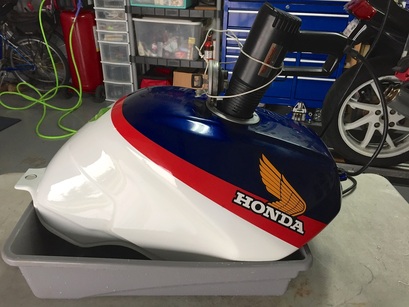
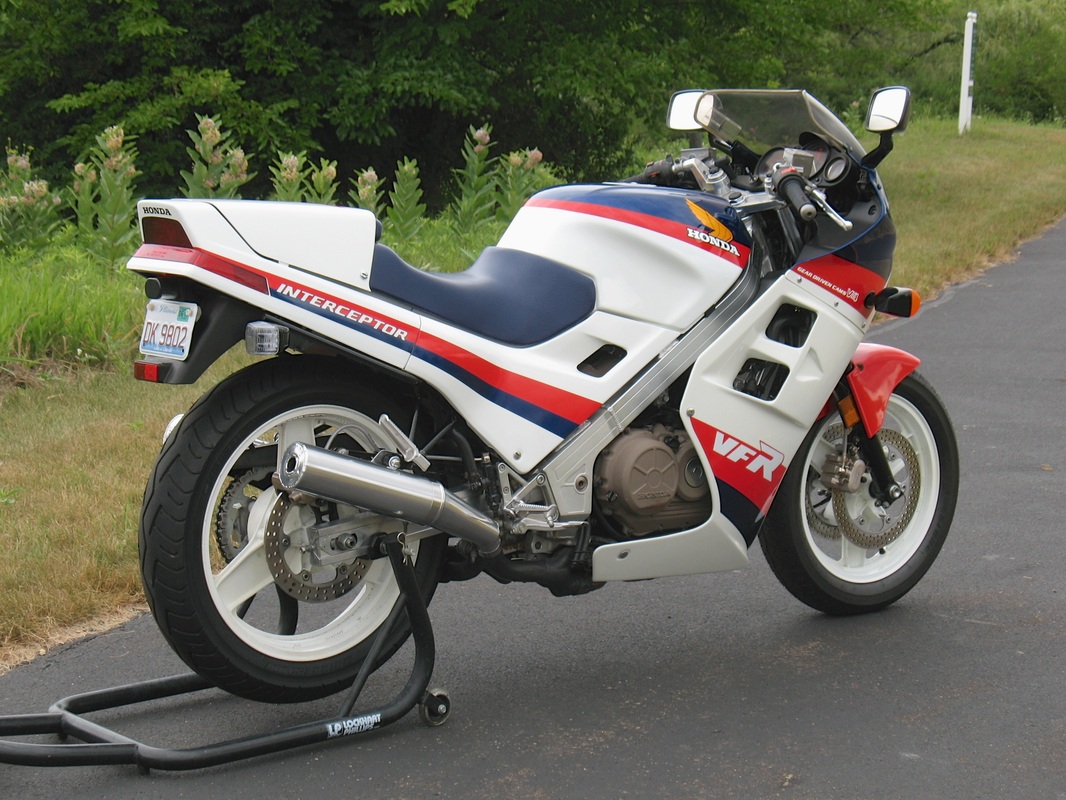
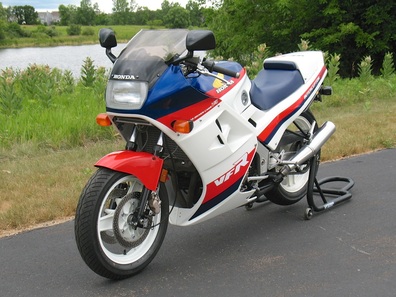
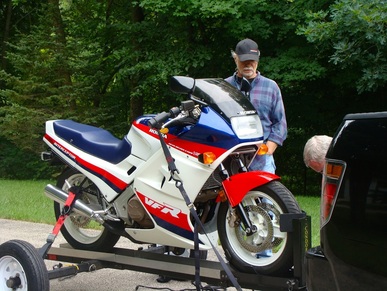
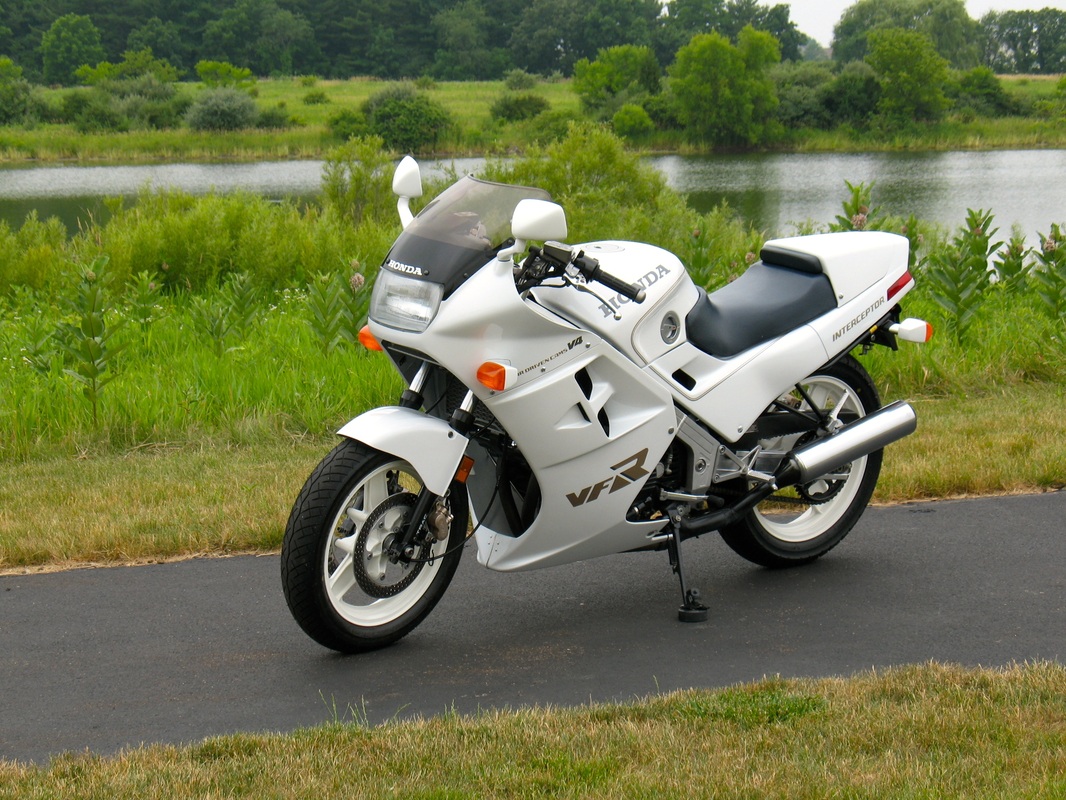
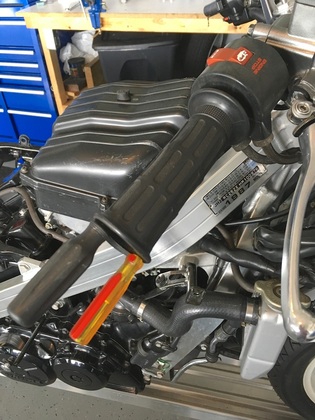
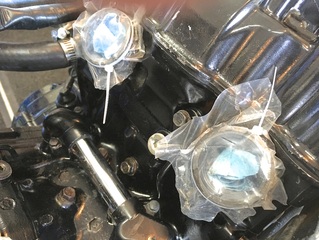
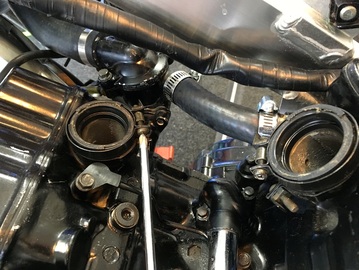
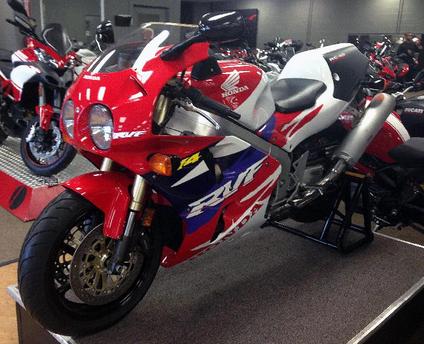
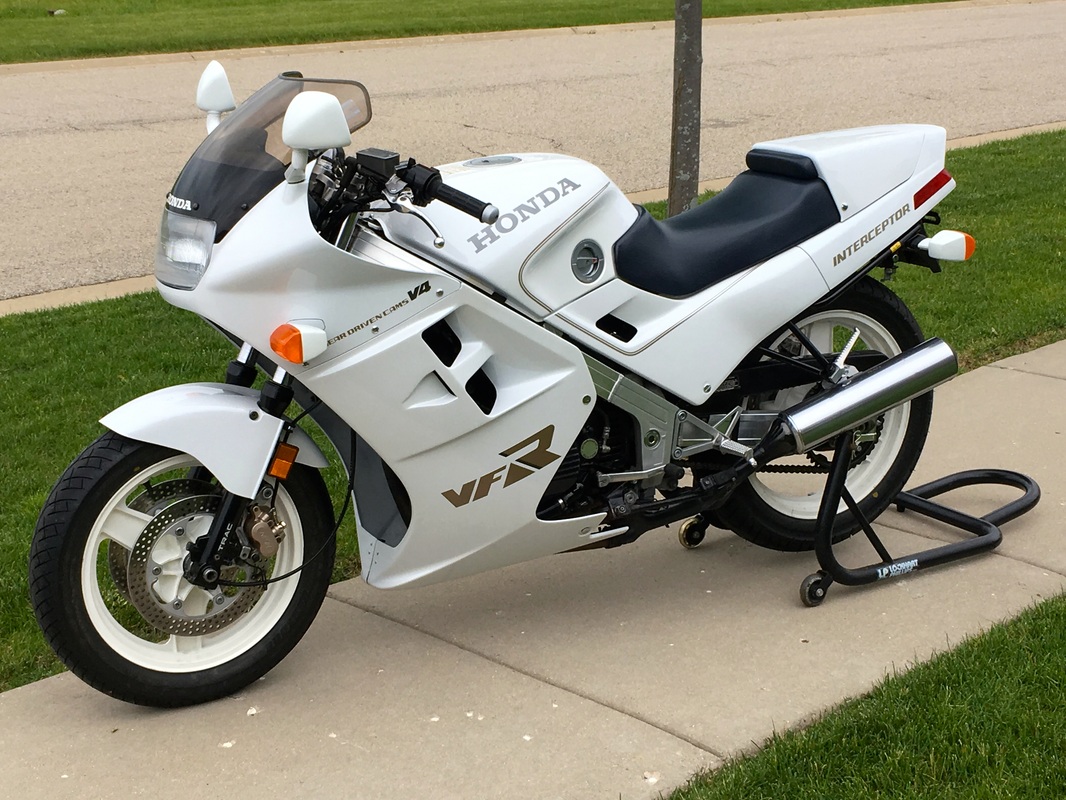
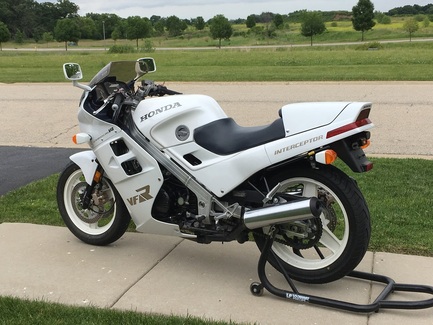
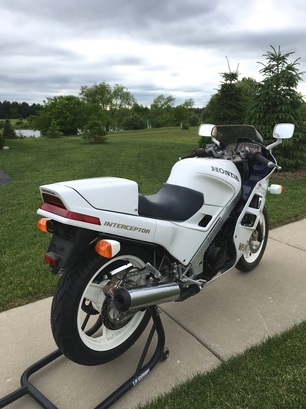
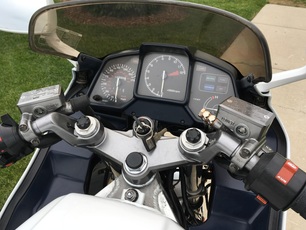
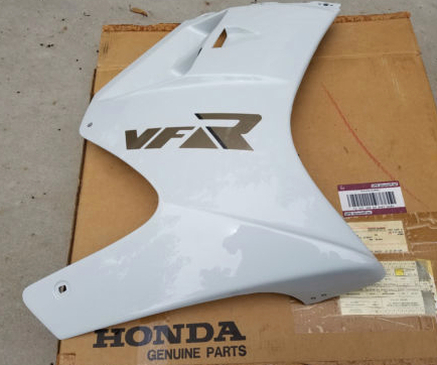
Project 15 is a gorgeous 1987 VFR700F2 in Crescent Pearl White with only 11,000 miles. This is a true survivor — I can't find any deviation from original equipment other than tires. Produced in October of '86 with production number 976. I found it last year in rural Ohio along with its stablemate, an '86 r/w/b 700. It runs and looks great, but I'll go through the systems and cosmetics in any case. The pearl white color was advertised as a "limited quantity" in 1986 and became a regular color for '87 along with the blue/silver paint scheme. My plan is to keep it in original condition with the exception of tucking in the turn signals, which is easily reversed. This should be a straightforward project and will definitely be a stunner. Stay tuned.
|
This past week I put Project 19 on the road for a 40-mile shake-down ride. The bike ran and rode perfectly...and it looks great! There's a few details to attend to before it's ready for photos and its For Sale sign. In the meantime, the next victim is on the rack for its tear-down and inspection. Project 15 is a gorgeous 1987 VFR700F2 in Crescent Pearl White with only 11,000 miles. This is a true survivor — I can't find any deviation from original equipment other than tires. Produced in October of '86 with production number 976. I found it last year in rural Ohio along with its stablemate, an '86 r/w/b 700. It runs and looks great, but I'll go through the systems and cosmetics in any case. The pearl white color was advertised as a "limited quantity" in 1986 and became a regular color for '87 along with the blue/silver paint scheme. My plan is to keep it in original condition with the exception of tucking in the turn signals, which is easily reversed. This should be a straightforward project and will definitely be a stunner. Stay tuned.
0 Comments
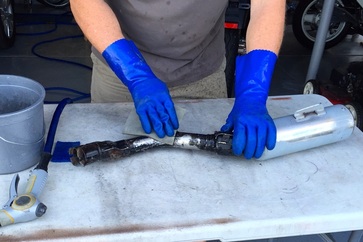
I was once pretty heavily involved in the homebuilt aviation scene, and there's an old saying with builders that the last 10% of the build is 90% of the work. I suspect that's true with lots of projects, from building airplanes to building homes. It's the finishing touches that eat up lots of time. But, I think those little bits are important. Case in point — turn signals. Project 19 is something of a resto-mod, with aftermarket pipes, carb tuning and performance air filter adding some punch, but the appearance remaining as close to the original red/white/blue as possible. As such, I wanted to keep the OEM signals as a nod to originality. Turn signals tend to take a beating over the years, what with them hanging out in the airstream, bumping into garage walls, shovels, kids bikes and sometimes asphalt. Fortunately, Honda chose to make the signal housings of solid-colored plastic, meaning they can be filed, sanded and polished to whatever degree necessary to work out most any rash — no painting required. So, off to the stash of lights to find a suitable set of front and rear signals. Here's a typical signal housing with its scuffed, scratched and dulled finish. First I remove the lens and bulb, and leaving the stem attached as a handhold, I begin the process of removing scratches by filing with a light metal file, then sanding with progressive grits of wet-dry paper till I have a smooth enough finish that machine buffing is able to bring back the shine. Basically the same process I use to refurbish aluminum parts. Each signal takes nearly an hour of work. And yes, I know reproduction signals are available, but what fun would that be? NOTE: This does NOT work on white colored signals & mirrors — they have a painted finish. When I'm satisfied that the signals are presentable, the lens' are installed and a final buffing finishes up the cosmetics. I like the signals tucked closer to the body, so I install them with shorter rubber stems. The rears are 3/4" stems from a VF500 and for the fronts I use the VFR rear stems which are 1 1/4" and bring the lights nearly flush to the fairing. The stems are available aftermarket from K&S. One more item checked off the list. I also use this technique on the mirrors and on windscreens. It ain't easy taking 3000-grit sandpaper to a plastic screen, but is often the difference between returning an original (and unavailable) windscreen to service or dropping it in the dumpster. And I prefer original parts. Now here's a project bike to sink your teeth into. Up for auction from Washington state is this wrecked 1990 VFR750R (RC30). This bike was involved in a street accident and purchased from the insurer with a salvage title. The seller is upfront about the extensive damage and has some of the replacement body plastics available for sale separately. He claims that the frame geometry is correct and ran the engine briefly ten years ago (!). Showing 17,000 miles, the seller has opened the bidding at $12,500, roughly half the value of your average, useable RC30. Your decision may hinge on how much trust you put into the seller's claim of an OK frame, as a replacement is as rare as a combat atheist. Should this end up being a track bike or put back on the street? The salvage title will forever haunt the bike's value as a street bike but, personally, I think a rider-quality RC30 would be the ticket. I think the seller may be shooting for the stars—I would be all over this project at about $7000. Bike builder Jeremy Malman knows there's at least two things wrong in this world that he wants to do something about: *The "skills gap" for skilled, hands-on workers in America; and, *At-risk kids in this country facing an ever more hopeless future. His shop, Worth Motorcycle Company, is a non-profit organization in New York City teaching these kids about life, bikes and self-worth. To keep the program alive, Jeremy has started a fund-raising campaign called "Building Worth." Here's the link with more details if you can help. https://www.razoo.com/us/story/Building-Worth-1 Project 19 came to me with a set of Cobra F1 aftermarket slip-ons. After a good scrubbing I was pleased to find that the mufflers have survived all these years free of road rash or other damage, with only light wear & tear. The pipes are aluminum and so can be massaged back to a nearly new condition with some basic effort. Here's a shot showing the upper muffler after a quick buff with Mothers polish. This closeup shows how nicely the finish can be transformed with very fine grit wet-sanding followed by hand polishing. Let's see what we can do with this scratch. First, I wet-sand with 400-grit till it disappears, then continue with successively finer grades up to about 2000-grit. Then several applications of polish till it matches the surrounding area. With the exhaust pipe's fresh coat of VHT black paint, this system will not only sound the part, but look it too. My Dad always said to take your time and use the right tool. For years I've been making do with a section of split PVC pipe as a make-shift fork seal driver. I do more than my share of '86-87 fork rebuilds, so I finally sprung for a Motion Pro 37mm driver and now wonder why I waited so long. This $40 driver is really well made, well designed and makes the job quick and precise. Highly recommended. I've never seen a problem with the 30-year old rubber brake lines on my Hondas. Having said that, they are 30 years old, and brakes are arguably the most important safety item on any vehicle. The Galfer braided stainless replacement lines that I use come as a two-line set (front), which replace the OEM three-line, eliminating the line joint in the middle of its run. The plastic sleeved lines are available in several colors — I choose clear or black, depending on my mood, I guess. The kit includes new bolts and copper sealing washers, and are clearly marked at the master cylinder attachment end. These are high quality items and and cost about $100 for a front and rear set. The peace of mind, however, is priceless. At some point in its life, project 19 developed a leaking battery case or, more likely, an overcharge condition which vented the electolyte overboard and onto the swingarm. This is the result, and it needs to be dealt with. I assumed that the aluminum arm was simply clear coated at the factory, but my efforts with paint stripper didn't faze the finish. I ended up sanding the affected areas with a metal prep pad on the die grinder down to the aluminum. After experimenting with various types and grits of wet/dry sandpaper, I eventually got the finish acceptably close to original. Because they're now bare aluminum, the refinished areas will require occasional future maintenance to keep their sheen. With the area cleaned and detailed, the wheel and brake can now be remounted, and project 19 will be back on its own two feet. I recently submitted this rare (in America) 1984 model VF to Bike-urious.com. Here's the write-up:
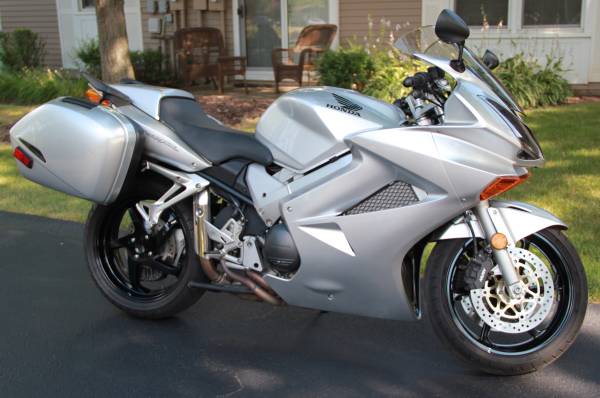
———-- Honda Motor Company bet a lot on the V4 engine concept in the early 1980's. They blasted the marketplace with a full range of styles and engine sizes, and the big gun was this baby, the VF1000R. America got the ill-fated "F" model in 1984, essentially an enlarged 750, replaced with the "R" in '85. But Europe went right to the "R" employing gear-driven cams, full bodywork, different wheels, brakes and more. Endurance racing was a Big Deal in Europe and that's the look Honda was after with the blunt fairing and dual headlamps. It was not to be. The big VFs were heavy, cumbersome handlers and couldn't compete with the latest inline fours on the street or track. The VF1000s left the market in 1986 amid a general slump in motorcycle sales worldwide. Our feature bike is a 1984 French model VF1000R. The import process has been completed and the seller indicates a clear title and the bike ready to ride. The photos show beautiful cosmetics and the VF appears to be in original kit with the unfortunate exception of an aftermarket exhaust, which promises a great-sounding V4 song, but for the purists nice OEM pipes are difficult to source. Value? Hard to peg, with an '84 "R" being so rare on these shores. Museum-quality, very low mileage VF1000Rs have brought over $12,000. ———-- Auction ends April 17th. EBay item number 162033510073 What: 2000 Honda VFR800 Where: Boalsburg, PA Why: This first-gen 800 may not be my favorite body style nor my favorite color, but it's a very well-presented example with a unique look and has been modified with very desirable suspension upgrades — Ohlins rear and Race Tech front. Fresh Michelins are a bonus and the seller even has the tool kit and owners manual (trust me, this is not usually the case). By the way, 2000 was the only year that Pearl Shining Yellow was available. The opening bid is $2700 and there's no reserve. Auction ends Thursday evening. Good luck to seller and buyer.
Update: SOLD at $3113 with six bids. |
THE SHOP BLOG
|


RSS Feed