Honda's V4 Interceptors
V4 Dreams
  • Home
  • Shop Blog
  • Maintenance
  • Products
  • My VFRs
  • Historical

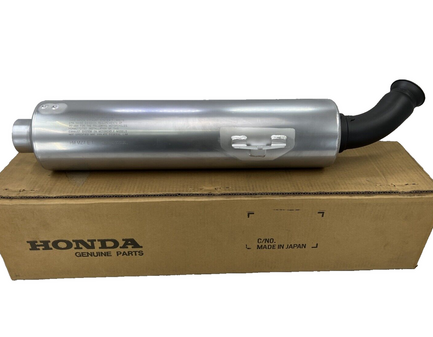
NOS Gen-4 Muffler On eBay

9/28/2025

0 Comments

 
PictureClick on image for the eBay link
A Minnesota eBay seller is offering this new-in-the-box Honda OEM muffler on an eBay classified for $499, including shipping. But, after a few days in my watchlist, I got a purchase offer for $399.

Described simply as "in great condition," the photos appear to show a never-mounted piece in new condition.

Just a reminder for anyone in the market for this — I have available a slightly used one for $150 (and other stuff):
https://flic.kr/s/aHBqjC7BCV

0 Comments

New Additions To The Products Page

9/26/2025

0 Comments

 
Over the years I've replaced untold number of damaged screws from previously serviced carburetor sets. Not surprising, really, considering most folks aren't familiar with the old JIS (Japanese Industrial Standard) screw head design and/or aren't equipped with the proper screwdrivers in any case. Honda's screws are often spec'd with kinda soft metal in many cases and breaking free screws which may have been in place for three or four decades often takes considerable force — the plenum-to-carb screws are a good example.

It has recently dawned on me that other home mechanics likely have similar issues with these screws, so I've decided to offer the most common offenders on the "Products" page of this website. There you'll find high quality replacements (some NLA from Honda), in the perfect size and quantity. I hope these items help out where needed. Click on the page header to navigate to the "Products" page.
0 Comments

Saving Parts

9/25/2025

0 Comments

 
Picture
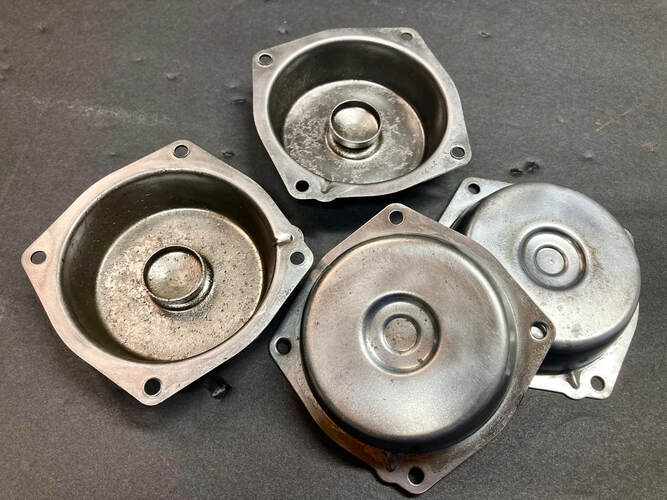
I'm currently working on a Gen-2 carburetor set which has obviously spent too much time in a corrosive environment, judging by the condition of the diaphragm caps' interiors.

This will test my philosophy of savaging parts rather than tossing them. Any time I can refurbish a durable original part and give it a new lease on life, that's my preference. In addition, these caps are NLA from Honda (actually, CMSNL has a few available: $53+ shipping & tariff).

Made of stamped steel and likely plated with zinc or cadmium, there's no reason these can't be reused. While this existing rust won't directly affect the carbs' functioning, I don't want to risk bits of flaking rust finding its way into the carb interior. Let's see what I can do with these.

(Below) As Neil Young reminds us, "rust never sleeps," so the long-term solution is to fully remove the rust. I'm going to use a mechanical and chemical approach, beginning with a small steel wire brush. That had minimal effect, so on to the Dremel, set at a fairly low 10,000 rpm, which was very effective, removing about 90% of the corrosion. Next up I try a simple vinegar bath. I expected to need at least 24 hours but after an overnight soak the rust appeared to be fully removed. One more pass with the Dremel using a soft brass brush inside and out, a wash, and finally a coating of metal preservative, in this case Corrosion X, but any light oil would help.

About 30 minutes of effort and minimal cost saved these parts, now ready for their second life.

Picture
0 Comments

1-hour Muffler Detail (Gen-4)

9/19/2025

0 Comments

 
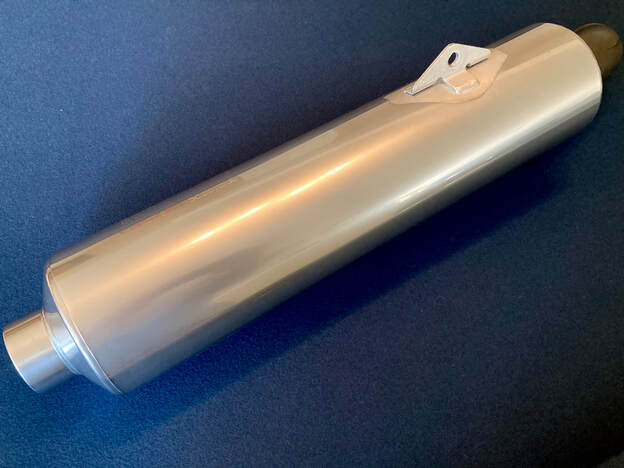
As I progress through my various surplus parts, I decided it was time to bring this 1994-97 VFR muffler off the shelf to prep for sale. This was already a beautiful survivor; no dents, a barely discernible 10mm scratch and original black paint still looking good.
Picture
This muffler is for sale; $150 including shipping
(Below) After a general cleaning, I can see the effects of 30+ years; a general dulling and light spotting taking hold. This should require just a light polishing to bring back the stainless finish — I say "light" because I know from experience that excessive polishing will go through the satin finish to a bright shine, and I want to preserve the original satin look.

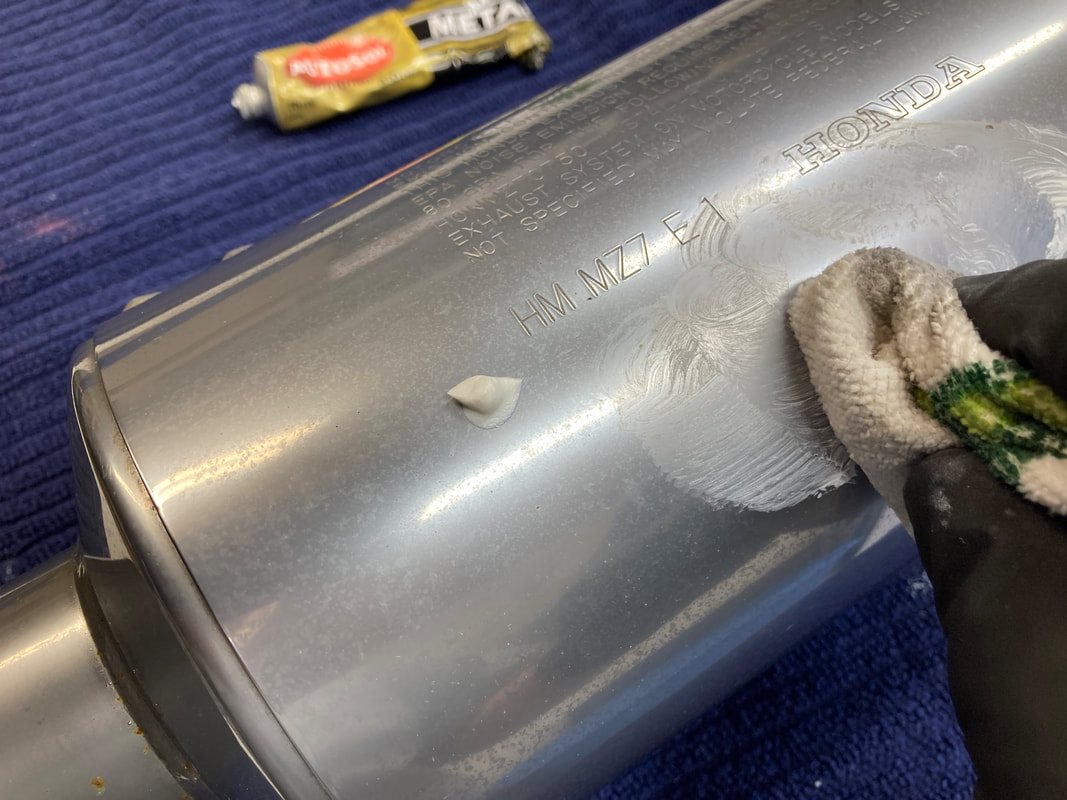
Today I choose Autosol polish (Amazon), a general metal polish that's been around for longer than me. In fact, any gentle metal cleaner will work, including good ol' Turtle Wax Chrome Polish & Rust Remover. The idea is to gently work the polish, just enough to remove the imperfections…and stop there. Remove the residue and give a final wipe with a microfiber cloth. 
(Below) Some of the heavier spots are superficial, often tar spots, which should come off with polish, and maybe a little help with a fingernail or plastic scraper. There is one spot on the this muffler (arrow) that got chipped deeply enough to cause a spot of rust. I'll try to deal with this after polishing.
(Below) The silver-painted areas surrounding the factory welds can be masked off and resprayed with silver high-heat paint but, again, I want to preserve the original finishes. I first gently pick off tar specks then wet-sand with a 3000-grit sponge, followed by a very gentle pass with polish. This paint is quite easily removed by sanding/polishing, so "gentle" is the approach here.
(Below) The small rust spot remains, so I spot treat it with a rust remover, applied with a cutoff Q-tip. After about 40 minutes it's as good as it will likely get, so I wipe with a wet cloth, dry and apply a dab of metal preservative. Touch-up with a dot of silver high-heat paint would be another option.
(Below) Finally, I want to address the black-painted exhaust pipe. In this case I deem the black finish is useable, so I first lightly wet-sand with 3000-grit and buff with a dry cloth, then apply rust remover to the one bad spot and touch-up with high-heat paint.

This could also be easily painted — remove any rust, mask off, apply four light coats of high-heat flat black paint, wait two days and hand buff with a clean, dry microfiber cloth.
Picture
(Right) A final polishing tip: For areas where a polishing cloth is ineffective, like this welded seam, a stiff toothbrush is helpful. I find medium stiffness brushes at Dollar Tree.

Any nicely preserved Gen-4 VFR should be proud to wear this muffler, and now it's ready for the next 30 years.

0 Comments

Old Gas Is Bad Gas

9/11/2025

0 Comments

 
No good will ever come of gasoline left to "mature" beyond its expiration date. Pictured below is a perfect example. The photo on the left shows what I found lurking inside a set of Gen-2 carbs, sent by a hopeful owner in the hopes of salvaging them. The second photo, of course, is the after shot. If you've never personally experienced this situation, I can assure you that black tar is just as nasty as it looks — foul, sticky, thick, gooey varnish. Obviously, these carburetors were saved, and here's how I tackled this nasty task.
(click on an image to enlarge)
Having tried a variety of cleaning/degreasing concoctions over the years, I have a few go-to products, shown below. I must have gone through at least 30 gallons of "purple degreaser" in my time. My local Menards big box store carries "Super Clean," so that's what's on the shelf. I typically use it full strength in a spray bottle as a parts cleaner, but in this case I diluted it 50/50 and let all the loose parts soak for hours, even overnight. It will affect aluminum if used too long or too strong, so be aware. I soaked the carb bodies themselves for only about four hours, then scrubbed the remaining residue with a stiff brush and rinsed with warm water. For the plastic floats, I soaked overnight and did a final gentle scrub with a medium-course green scrub pad. I soak the floats in a 32-oz Mickey-Dees drink cup, held submerged with a suitable weight, like a the handle end of a screwdriver. This will also allow you to check them for leakage, which I've never found.

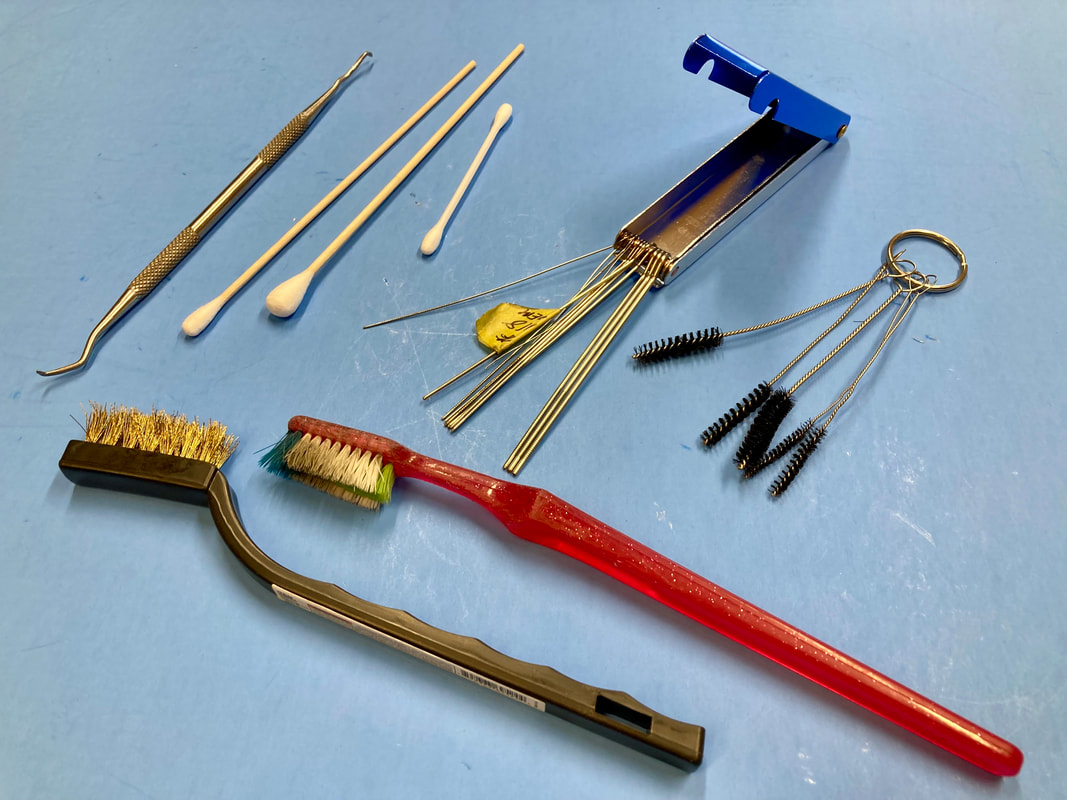
For the really heavy deposits, I spray on "Gum Cutter" and scrape with a pick, then brush with a small brass scrub brush (Harbor Freight or Amazon). 

The pilot jets were replaced with new #40 jets from EBC, but they can be cleared, if desired, with a very tiny wire after soaking. The remaining jets were soaked and their orifices gently cleared with jet cleaning wires followed by small scrub brushes soaked in Gum Cutter. The float valve needles are replaced with new Viton-tipped needles.

I didn't use it in this case, but an alternative is Berryman's "Chem-Dip." The parts would be soaked for many hours, even overnight, then rinsed, scrubbed and cleaned as above.

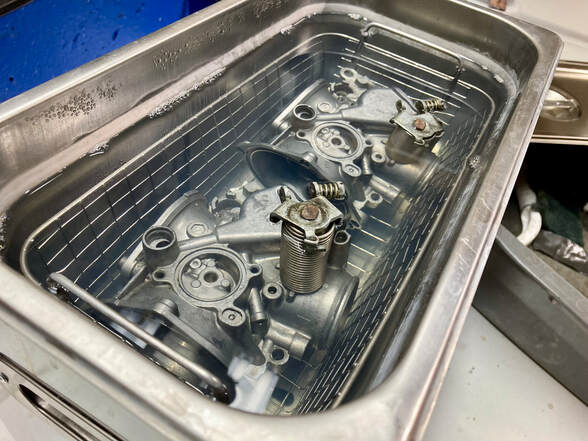
All of this is in preparation for the final cleaning step, a refreshing agitation in the ultrasonic cleaner (all except the floats). Just about any cleaner can be used in a sonic cleaner, but my go-to is "Clean 2020" from Master Fluid Solutions (find it on Amazon). Not cheap, but it's diluted 10:1, so a gallon goes a long way, and it can be used several times. depending upon how nasty your stuff is. I run the ultrasonic cleaner at 40° C and do two 20-minute cleanings with about a 30-minute cooling period in between — these machines can overheat. My 6-liter cleaner can hold two VFR carbs at a time.

While the ultrasonic cleaner does its magic, I spend that time hand cleaning all the other miscellaneous bits, like brackets, pilot screws, bowl drain screws, scraping old bowl gaskets, etc. I also inspect and clean or replace stuff like air cut valve and choke valve assemblies.

When the carb bodies are finished with their cleaning, I rinse and immediately blow out every passage and orifice with 100-lb compressed air, followed by manually blowing through those (via a short length of hose) to verify clear. Once satisfied, assembly can begin.

I'm in the process of putting together a thorough step-by-step tutorial on my rebuilding process, but it's slow going, so look for that in the future.
Picture
0 Comments

Separating Carburetors, The Easy Way (Gen-2 & 3)

9/7/2025

0 Comments

 
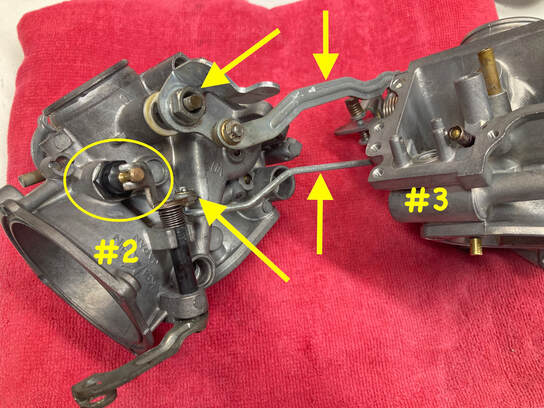
When doing a complete rebuild on 1986-93 VFR carburetors, I have the option of leaving #2 & 3 carbs joined by the throttle and choke linkages (shown by arrows in the photo), which will simplify the disassembly/reassembly process. The deciding factor here is the condition of their respective "starter valve sets," as Honda calls them (circled in the photo), which cannot be removed with the linkage fully attached. If the valves are clean and operating freely the linkages can be left in place for cleaning, If not, or if you're just OCD like me, then here's the simplest way I've found to remove the linkages and separate the carbs. These photos show a Gen-2 carb set, but the Gen-3 is very similar.
Picture
My technique involves removing the linkages from #2 carb only. This will provide just enough additional movement of the respective actuating levers to allow the valve sets to slide outward and free.

(Below) We'll begin with the easy one; the throttle. While holding the surrounding bracket very firmly with a pliers, remove the 11mm nut and lock washer and work the assembly off its shaft. Be careful how and where you hold the bracket to avoid bending the flat plate, which would later affect the throttle opening.
(click on an image to enlarge)

(Below) Now to the choke linkage. First, I need to remove the tiny cotter key; I either carefully straighten the bent tails of the key or just cut them off flush with a wire cutter, then pull the key free with a small needle nose pliers (be sure to have a replacement cotter key on hand). Slide the linkage out the bottom of the bracket, noting the location of the upper and lower washers. Number 2 carb is now free. Both linkage arms will remain attached to #3.
(Below) The starter valves can now be worked free. First, I'll need to temporarily remove the choke lever on #2, as it has a cast-in stop which won't allow the actuating lever to open far enough for our purposes. With a pliers, remove the nut and lock washer, then the lever, noting its orientation for reassembly (as soon as the starter valve is removed, you'll reattach the arm). You have the option of removing the entire shaft, black plastic sleeve and spring if desired. If you do (or it all slips free) note the orientation of the spring.
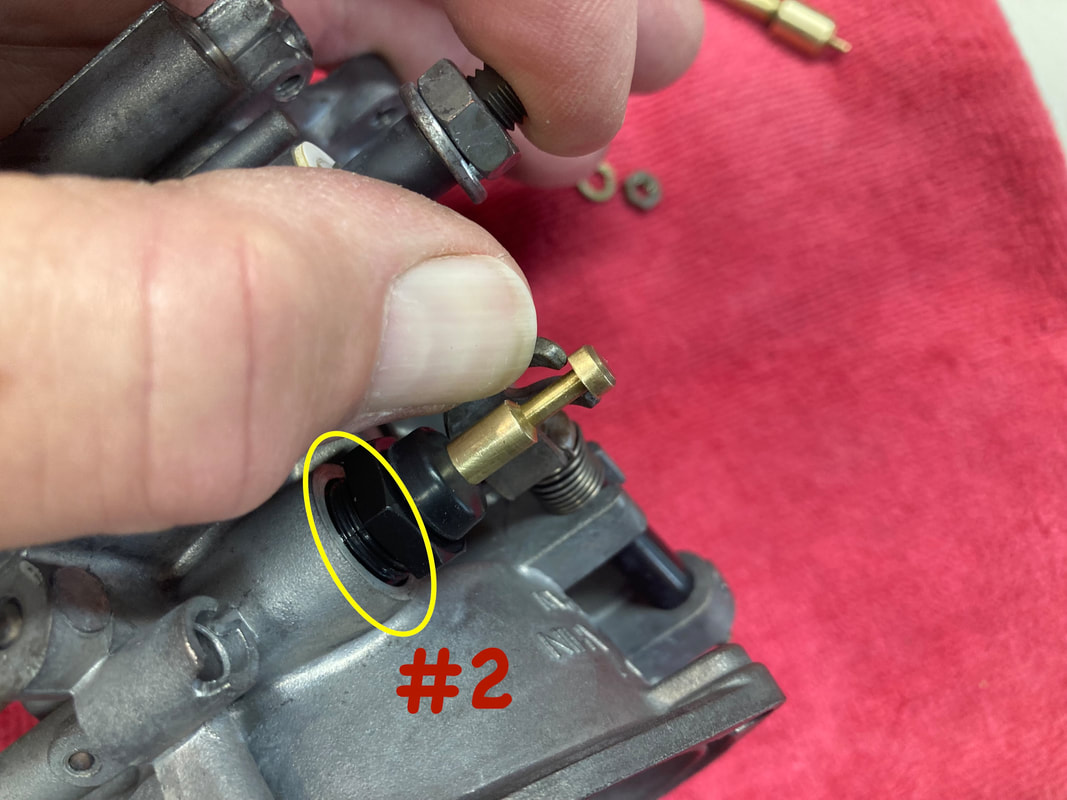
Caution: This is an exercise in finesse, not force. You may be tempted to bend the little ears on the actuating levers — resist this, as the soft metal will easily fatigue and break. Referring to the photos below, note that the valves' plastic nuts are slightly unthreaded — break them free with a 14mm wrench or pliers, then turn by hand. This is necessary to allow the valve shaft to extend far enough out to just clear the levers' ears — unscrew too far and the nut will foul the actuating lever. Experiment with unscrewing the nut till you find the sweet spot which allows the ears to rotate far enough to clear the shaft while simultaneously pulling outward on the shaft. Rotating and holding the spring-loaded shaft clear, the nut can then be fully unscrewed and the starter valve assembly removed. This becomes easier after about the tenth time you've done it ;-(
Note: After removing #2 valve assembly, reinstall the choke lever — this will hold the shaft, plastic sleeve and spring correctly in place during the cleaning phase.
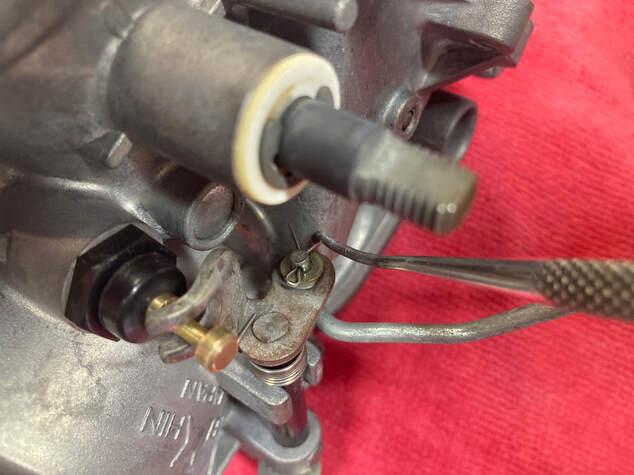
Reassembly, as they say, is the reverse of disassembly. First, install the starter valve assembly in #3, then #2, then the two shafts onto #2. (Below) When installing the tiny cotter key, I bend its tangs with a dental pick.

Congratulations on completing a procedure that intimidates even experienced mechanics.
Picture
0 Comments

Bridgestone Rebates Are Back

9/3/2025

0 Comments

 
Bridgestone is offering a Fall price break on new tires. I don't see my personal favorite for the 1st & 2d-Gen VFRs, the BT46, but my go-to tire for the later generations are — the T32 & T33. As always, Rocky Mt. ATV/MC offer good pricing, free shipping and will file the rebate paperwork for you.
​https://www.rockymountainatvmc.com/tires-and-wheels/motorcycle-tires?v=1993-HONDA-Interceptor-750-VFR750F
Picture
0 Comments

    THE SHOP BLOG
    •••

    An on-going account of miscellaneous information, project bikes and noteworthy VFRs for sale


    Archives

    February 2026
    January 2026
    December 2025
    November 2025
    October 2025
    September 2025
    August 2025
    July 2025
    June 2025
    May 2025
    April 2025
    March 2025
    February 2025
    January 2025
    December 2024
    November 2024
    October 2024
    September 2024
    August 2024
    July 2024
    June 2024
    May 2024
    April 2024
    March 2024
    February 2024
    January 2024
    December 2023
    November 2023
    October 2023
    September 2023
    August 2023
    July 2023
    June 2023
    May 2023
    April 2023
    March 2023
    February 2023
    January 2023
    December 2022
    November 2022
    October 2022
    September 2022
    August 2022
    July 2022
    June 2022
    May 2022
    April 2022
    March 2022
    February 2022
    January 2022
    December 2021
    November 2021
    October 2021
    September 2021
    August 2021
    July 2021
    June 2021
    May 2021
    April 2021
    March 2021
    February 2021
    January 2021
    December 2020
    November 2020
    October 2020
    September 2020
    August 2020
    July 2020
    June 2020
    May 2020
    April 2020
    March 2020
    February 2020
    January 2020
    December 2019
    November 2019
    October 2019
    September 2019
    August 2019
    July 2019
    June 2019
    May 2019
    April 2019
    March 2019
    February 2019
    January 2019
    December 2018
    November 2018
    October 2018
    September 2018
    August 2018
    July 2018
    June 2018
    May 2018
    April 2018
    March 2018
    February 2018
    January 2018
    December 2017
    November 2017
    October 2017
    September 2017
    August 2017
    July 2017
    June 2017
    May 2017
    April 2017
    March 2017
    February 2017
    January 2017
    December 2016
    November 2016
    October 2016
    September 2016
    August 2016
    July 2016
    June 2016
    May 2016
    April 2016
    March 2016
    February 2016
    January 2016
    December 2015
    November 2015
    October 2015
    September 2015
    August 2015
    July 2015
    June 2015

    Categories

    All

    RSS Feed

Site powered by Weebly. Managed by HostGator