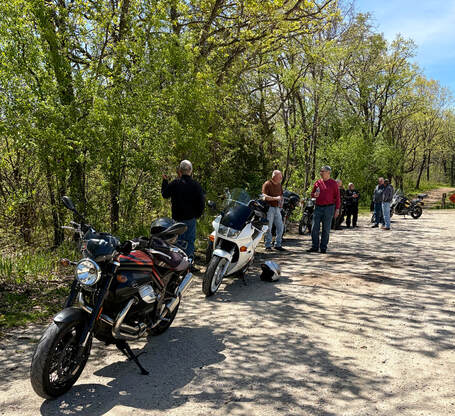
 The Griso and VFR take a breather on a perfect day in Waukesha County, WI
 A few months ago I advertised an unused container of aluminum cleaner on FB Marketplace and when the buyer, Rob, showed up I happened to ask him what he planned to use it for.
It was at this point that our worlds began to merge as we shared our moto activities, Rob mentioning that one of his more recent acquisitions is a Moto Guzzi Griso which he'd purchased in the Cincinnati area from a guy named Rick. A dim bulb lit in my memory as I connected the dots to my "Blue Ridge Dreamin'" trip of September 2023, where I rode with a Griso…owned by a guy named Rick…from Cincinnati.
Yep, same bike, now residing in our small town in Illinois. Well, turns out Rob is part of a local group of guys who, for years, have regularly ridden together in southeast Wisconsin and call themselves the "Geezers." All the guys seem to have long moto histories and ride, wrench and live bikes. Rob graciously invited me to join a group ride a few weeks ago and again yesterday.
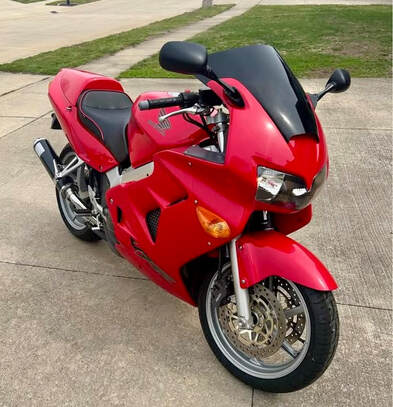
My day began at 7:30 with unseasonably crisp temperatures but blue skies and bright sun as I swung a leg over the '93 VFR and steered toward the meetup point outside Twin Lakes, WI. This was the VFR's debut with the group so it got its share of attention while we talked as today's riders rolled in. Only nine bikes this morning as we rode to our breakfast stop at the friendly Princess Cafe in East Troy. After fueling our bodies, Rob led us through a maze of twisty Wisconsin backroads toward the southern section of the Kettle Moraine State Forest. We took a butt break in the heart of "The Kettle" along Hwy ZZ followed by a great ride along several of the area's finest roads — twisty, smooth, with pastoral scenery and mostly devoid of traffic on this Thursday morning. One more group stop in Eagle before working our way toward our respective home bases, eventually shedding riders till I was solo for the final ten miles or so, gliding into the garage at 2:30, the trip meter showing 135 miles.
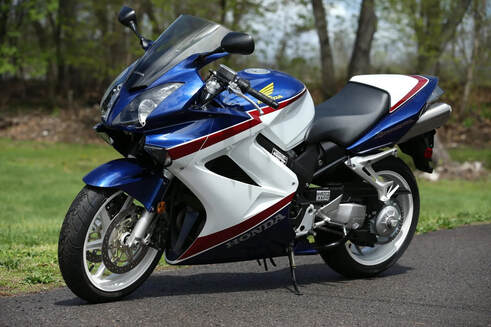
The VFR, of course, was the perfect riding companion. When the curves appear or the speeds pick up, this bike responds with confidence-inspiring ease, true to its VFR lineage. The changes I've made to the bike's ergonomics give these old joints a break, making a day ride like this a pleasant experience.
I've always been, let's say leery, of group rides. Unless you have confidence in all the other riders, it can be more nerve-wracking than relaxing. Not so in this case. After two rides, I have no qualms with this group — they are obviously experienced and capable riders who ride their own rides with poise and skill. I hope I've demonstrated the same, and that they might welcome me in the future.
It was at this point that our worlds began to merge as we shared our moto activities, Rob mentioning that one of his more recent acquisitions is a Moto Guzzi Griso which he'd purchased in the Cincinnati area from a guy named Rick. A dim bulb lit in my memory as I connected the dots to my "Blue Ridge Dreamin'" trip of September 2023, where I rode with a Griso…owned by a guy named Rick…from Cincinnati.
Yep, same bike, now residing in our small town in Illinois. Well, turns out Rob is part of a local group of guys who, for years, have regularly ridden together in southeast Wisconsin and call themselves the "Geezers." All the guys seem to have long moto histories and ride, wrench and live bikes. Rob graciously invited me to join a group ride a few weeks ago and again yesterday.
My day began at 7:30 with unseasonably crisp temperatures but blue skies and bright sun as I swung a leg over the '93 VFR and steered toward the meetup point outside Twin Lakes, WI. This was the VFR's debut with the group so it got its share of attention while we talked as today's riders rolled in. Only nine bikes this morning as we rode to our breakfast stop at the friendly Princess Cafe in East Troy. After fueling our bodies, Rob led us through a maze of twisty Wisconsin backroads toward the southern section of the Kettle Moraine State Forest. We took a butt break in the heart of "The Kettle" along Hwy ZZ followed by a great ride along several of the area's finest roads — twisty, smooth, with pastoral scenery and mostly devoid of traffic on this Thursday morning. One more group stop in Eagle before working our way toward our respective home bases, eventually shedding riders till I was solo for the final ten miles or so, gliding into the garage at 2:30, the trip meter showing 135 miles.
The VFR, of course, was the perfect riding companion. When the curves appear or the speeds pick up, this bike responds with confidence-inspiring ease, true to its VFR lineage. The changes I've made to the bike's ergonomics give these old joints a break, making a day ride like this a pleasant experience.
I've always been, let's say leery, of group rides. Unless you have confidence in all the other riders, it can be more nerve-wracking than relaxing. Not so in this case. After two rides, I have no qualms with this group — they are obviously experienced and capable riders who ride their own rides with poise and skill. I hope I've demonstrated the same, and that they might welcome me in the future.


 RSS Feed