|
I've been busy for several weeks preparing all the large and small bits for final assembly on Project 41, a 1987 VFR700 F2. The goal is to have everything sitting ready on the shelf when its time comes. The bodywork is finished, tires mounted, small bits gathered and refurbished and the machining required for the fork emulator install has been completed. I'm currently awaiting delivery of the new shock which will allow the rear of the bike to be assembled, the build proceeding quickly from there.
0 Comments
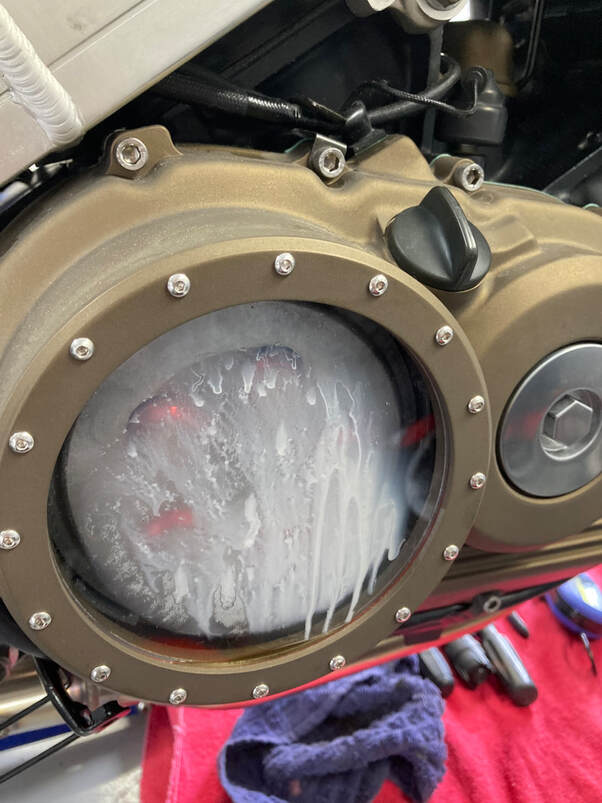
I recently received Project 41's engine covers back from Tom at Tom's Cycle Recycling (https://www.facebook.com/Tomk1960/) showcasing his usual powdercoat perfection. Finished in Textured Gold Dust, the idea is to mimic the unique-colored covers from the 1986 VFR, while providing a deeper, richer color. These covers are special — they're made of magnesium, shared with more exotic factory-prepared machines like the RC30 and RC45, IRRC. To my knowledge, Gen-2 VFRs are the only generation of standard production models to sport magnesium covers. Let's go through my part of the process to get to the finished product, beginning with disassembly. Powdercoating requires media blasting and baking in high heat, so everything must be stripped from the assemblies. For the clutch/alternator covers, this begins with removal of the (sound?) baffles on the backside of the covers. A single bolt holds each plate and its rubber gasket, which are lock-tighted in place, requiring an impact tool for removal. (click on images to enlarge) For the valve covers, I'll need to remove the rubber gaskets and the rear cover's oil baffle assembly, where I discover a paper gasket (a first for me) in place of the typical stamped metal (below). The metal is reusable, but the paper version shreds upon removal. Neither is available from Honda but, fortunately, a paper replacement is available from the aftermarket, about $13 on eBay. Once stripped down to the bare covers, I address any cosmetic damage. In this case only the lower portion of the alternator cover had some road rash. I smooth out the metal with a combination of light sanding discs on a die grinder followed by hand sanding till smooth. After Tom works his magic, I give all the parts a soapy bath and hot rinse to ensure nothing harmful is left behind, then assembly begins with remounting the oil baffle (below). Next, I'll assemble the side covers (below). I lay the sound baffle's rubber gasket in place, set the baffle in the gasket's groove and lay the rubber washer and its metal cap in place. After degreasing the bolt, I'll coat with red threadlock and tighten the bolt very securely. Note which side of the baffle plates face upward. Next, I install the rubber valve cover gaskets (below). The Honda manual states to "apply sealant between the gaskets and cylinder head covers." I've never found this to be necessary, except to add six or eight dabs of gasket cement or similar (center photo) in order to hold the gasket in place when it's tipped upside down during installation onto the engine. I let the cement set up for a few minutes and then test that the gasket stays in place long enough to allow installation. The manual also states, "apply sealant around the projections of the gasket." I have no idea what they're referring to, but I've never had a reused valve cover gasket leak when installed dry. YMMV. Finally, I spend some time with the timing hole cover. The cover can be powdercoated, of course, but I like the contrasting polished aluminum look. After chemically stripping the original black paint (in this case) I wet sand with three or four grits till I'm happy with the look, then coat with Sharkhide to protect the raw aluminum finish. The manual wants us to coat its threads with moly grease, and I also add some to the o-ring, which I always reuse. Snug in place with a 17mm socket, and these parts are ready to rejoin the engine…a future post.
Click on image for the eBay link What: "Norceptor" Why: I got nothin' Where: Dallas, Texas Price: $3600 opening bid With full appreciation that our Honda V4s are great engines and relatively unique in the classic moto world, this build is still a head-scratcher. The practice of swapping Triumph/Norton/Vincent engines and frames was popular back in the day for one good reason: the sum could be made better than its parts. The Norton "Featherbed" frame, for example, was considered the gold standard of the 60's era production bikes so it kind of made sense and was a fun (and relatively easy) exercise. But this collection of parts is none of that. Based upon what appears to be a '73 Norton frame, complete with a single Lockheed disc squeezer up front (barely better than the drum it replaced), ancient drum out back, along with spindly tires and suspension, this bike will transport the rider back to the bad old days of British "dominance." Lest one assume I know not from whence I speak, I should mention that my first crankshaft-up restoration was a '72 Norton Commando roadster. I loved much about that machine (on a good day) but its performance was greatly derived from its relatively light weight, giving a good power-to-weight ratio (for the time) and helping to mask the weak suspension, brakes, and flexible frame. Inserting a heavy 80 HP V4, plus its cooling system, into a 1950's-derived chassis is the definition of going backwards in moto evolution. I really do appreciate folks who think outside the box and have the determination, time and skills to make it a reality, but some ideas just make more sense than others. I can't even imagine this thing going down the road at any speed ("frame welds need attention for riding again") but with an opening bid of $3600 and no title provided, that likely won't happen in any case. Click on image for the eBay link Time, rarity and inflation conspire to up the cost of our hobby, and here's some current examples, specifically for the VFR750R. Ebay seller, adrenaline_cycle, has two RC30 items up for sale. How about a vintage tool kit in an old-school fabric wrap: $1000 or offer plus $20 shipping. They also have a set of used mirrors, stated to be "factory OEM" though they're in black and the mounting doesn't look right, at least for the 1990 US model: $600 or offer plus $15 shipping. For a potentially better deal on the above tool bag, here's a set up for auction, opening bid at $499. From France we have a used 8-spoke rear wheel for a cool $862 plus $145 shipping to the US (current exchange rate). Having recently completed the paintwork on Project 41, I can verify that the cost of paint and labor has also transported those costs into a new realm. It's all relative, of course, and we play with old motorbikes for nobler reasons, right? I nipped this photo from the ADVrider.com VFR thread, posted by Guano11. Three beautiful bright red VFRs; two Gen-3 and a Gen-5 getting exercise on a ride to Windy Ridge, a well-known run near Mount St. Helens in Washington state.
https://en.wikipedia.org/wiki/Windy_Ridge_(Mount_St._Helens) NOTE: I have no affiliation with this sale. Click on image for the Marketplace link What: 1986 VFR700 F2 Why: Nicely Refurbished VFR ;-) Where: Naperville, Illinois Price: $3900 asking I came upon this FB Marketplace listing this morning and instantly recognized it as one of my projects. I completed and sold this very nice 700 in October of 2021 and it's accumulated less than 800 miles since that time, now showing just over 32,000. The seller notes the very nice period-correct Corbin seat, but doesn't mention a few additional details like stainless brake lines or the custom "shorty" mufflers. I make these mufflers by shortening the originals by 5 1/2 inches, then painting them either silver or black. They sound great and, of course, fit the bike perfectly. I don't recall if I had the bike repainted but I think some of the panels may have been. I do know that the swingarm was stripped and polished, and there's later model front brake/clutch masters installed. The '86 F2 models came with the brown engine/valve covers and these are original, and the instrument nacelle was changed from the original blue to satin black. All the systems and cosmetics were attended to, as are all of my projects. The seller states the it "runs excellent and looks the same." This one deserves more seat time — here's your chance at a very nice Gen-2 VFR. Contact the seller via the Marketplace link in the lead photo. Just when we feared that Airtech had left the building, it looks like their products will once again be available.
I received an email announcement last week from Gustafsson Plastics announcing that they have acquired the Airtech company's name and molds, and have combined their windshield products with Airtech's bodywork products, now supplying both under the new name of GP Cycle Works. The finalized website is not yet up, but they say they are fulfilling orders. https://bikescreen.com/ Click on image for the eBay link What: 1991 VFR750F Why: Nice survivor Where: Las Vegas, Nevada Price: Auction ends Oct 13 UPDATE: No sale; no bids beyond the seller's $2000 opening bid Here's a good old fashioned no-reserve auction on a very nice, 28,545-mile Gen-3 rider-grade survivor. Sporting a Vance & Hines slip-on, freshly serviced carbs, tires, clutch, battery and more, this looks to be a ready-to-ride example. I suspect there's been a repaint at some point, and the bike is clean and well presented. Our seller states the bike "runs and rides great." I stole this image off the RC24/26 FB page. No information included, but it is certainly an interesting build of someone's V4 ADV vision. Starting with an RC24 frame, that might be a Honda Hornet tail fairing and seat grafted on with a custom-made bracket for side bags and top trunk fitment. The wheels appear to be CBR conversions, which would be needed to fit those very aggressive ADV tires.
Other than the fuel tank the original bodywork is gone, replaced by a universal Givi round headlight fairing, and some sort of custom or grafted on radiator support and unknown small brackets on either side, which also carry aftermarket lights. I think the radiator might be a larger unit from another model. There's also a hefty bash plate and frame protecting the engine lowers, but the left coolant hose looks vulnerable. The coolant overflow tank has been relocated further forward and the oil cooler moved to a lower position — curious for the bike's intended purpose, but may have been necessitated by the radiator mods. The forks, swingarm and brakes appear original while the handlebars are some sort of conversion. Someone spent a lot of time and effort on this build. The bike actually cuts a decent naked-bike profile and, other than those rumbling tires, might make for a fun street ride. As for attacking dirt, gravel, ruts and bumps of off-road riding, I would be hard to convince that a heavy, high-revving V4 with limited suspension travel would be high on my list of choices. Click on image for the eBay link This appeared on my morning eBay feed — the most coveted VFR item ever produced. Here's a very nice 8-spoke rear wheel from a Gen-3 1991 VFR750, still in its factory color. These wheels, of course, also fit newer VFRs up through the Gen-6, IIRC, giving a bit of style and flair to those models. This one is listed at $395 + $55 shipping from California. That's about the going price for these, and the seller states that the rim is straight. Here's your chance….and this seller has many more Gen-3 parts from this '91 listed for sale. |
THE SHOP BLOG
|


RSS Feed